Pages

Tuesday, 27 July 2010

Agile: Guidelines or methodology?

Another discussion on LinkedIn, this time about whether Agile is a methodology or just guidelines. The consensus seems to be guidelines, which seems to reflect the spirit of Agile better.

But at the same time, this view seems only to address Agile in the abstract, not Agile (or any other delivery model) as implemented in any real organisation. Which is a pity, because it is at that point that the strains will start to be felt if Agile remains no more than guidelines. On the other hand, to convert it to a formal corporate methodology would not only defeat much of its underlying philosophy and approach but also lead to Agile being ossified in the same way that waterfall – which was never inherently rigid or bureaucratic – was ossified by immature implementations and too much top-down corporate management freakery.

And of course, there always been legitimate management reasons why Agile cannot be left to go its own way, any more than any other management tool. There will be inescapable (and entirely reasonable) reporting requirements, stakeholders will often want to know what progress is being made in non-Agile terms, and so on.

So, for any organisation that does not want to see something as promising as Agile degenerate into either paperwork or making it up as you go along, it is necessary to be rather more specific about how either a Agile-as-methodology or Agile-as-guidelines is implemented.

So even if Agile is to be forced into the mould of a corporate methodology, any self-respecting implementation can features that prevent it from becoming a rigid, inappropriate and self-defeating. For example:

  • It will be specifically tailored to the type of work that is really being done.
  • It will be abstract enough to permit considerable leeway for professional judgement.
  • It will be fully scalable (no, not just big, medium and small).
  • It will include user-friendly mechanisms for granting exceptions and waivers.
  • It will include wide-ranging but rigorous (the very opposite of rigid) ranges of meaningful options.
  • It will be implemented through training and tools, techniques and templates that make explicit the team’s authority to vary, depart from or just plain ignore the ‘rules.
And so on.

I don’t see that any of this gets in the way of Agile, or how any complex organisation could safely or profitably implement it without at least a few of these quite standard methodology components.

Friday, 18 June 2010

How good is DSDM?

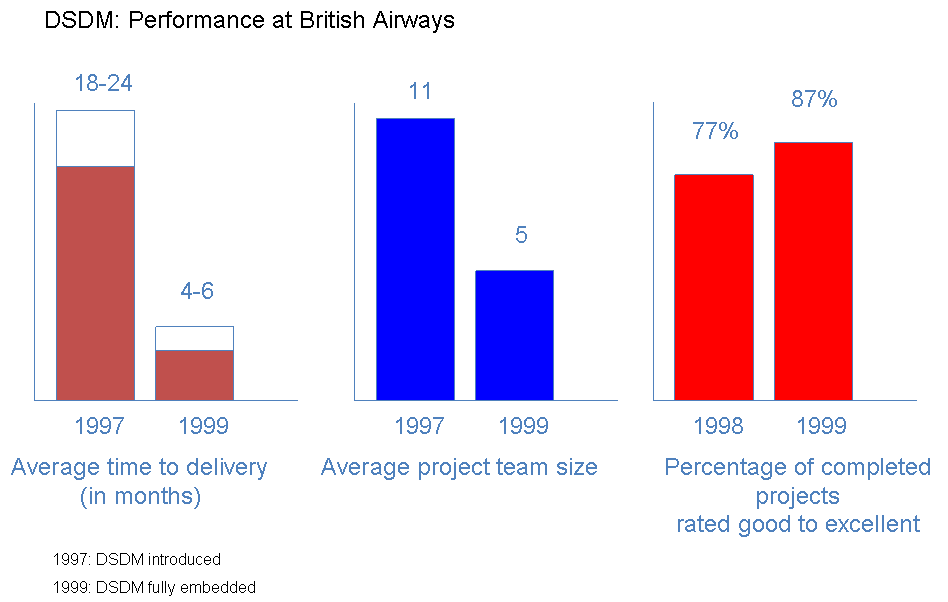
I recently initiated a discussion on LinkedIn entitled How good is DSDM? Although there was (unsurprisingly) a consensus that DSDM was A Good Thing, we were collectively unable to come up with much hard data until Jennifer Stapleton – a past Technical Director of the DSDM Consortium – kindly offered me some data from Xansa (bought by Steria in 2007) and British Airways. Xansa’s data is especially interesting, as it covers a number of clients (including BT) and Xansa was, at that time, the world’s largest DSDM practice.

The gist of the data is that DSDM offers huge improvements in productivity, team size, delivery time and project quality. Here are the basic graphs (not as contemporary as I'd like, but still solid data):


Friday, 11 June 2010

What, ultimately, is Agile about?

There is an interesting discussion of Agile going on at LinkedIn at the moment. The topic under review is 'Transitioning from command and control to a servant based style of leadership'. personally I think the idea of 'servant leadership' is both misconceived and redundant, as the answer (so far as I understand the issue) was provided by the German sociologist Max Weber about a century ago.

In brief, at least as far as successful Agile projects are concerned, I suspect that this change in the way organisations work under Agile is closely connected to the distinction between being a professional and an employee.
  • An employee is someone you pay to be able to tell them what to do, and is best suited to command and control.
  • A professional is someone you pay so that they will tell you what to do, and so works better in a collaborative environment - which Agile is designed to create.
Conversely, I suspect that whether an Agile initiative is successful depends heavily on the extent to which truly professional capabilities and a professional culture exist. In that respect it would be very interesting to hear from people for whom Agile had not worked as to why it had failed.

Note the causal direction. If companies insist on command and control, they get employees – i.e., people who need to be told what to do. If you give people opportunity and responsibility (and a non-trivial amount of skill), you will get professionals.

On the other hand, the training and coaching needed to get people who were previously treated as employees to operate as professionals (and therefore suite to Agile) can be very great. The transition is not easy or straightforward, not least because the skills required are by no means solely technical. There are personal and social capabilities that are also required to succeed at Agile. But they are encompassed by the concept of professionalism.

This can be exemplified by a major cultural problem Agile implementaitons often seem to face, namely empowering staff saying no to their boss (eg, the Agile PM). Managers need technical training (i.e., how to do Agile) but other team members need the social and personal ability to insist on their own professional perspective. Few organisations cultivate this attitude (though I have known a few), but I would say that it is crucial to making a success of Agile.

The same point applies at the other end – to business stakeholders. They also frequently need a change of culture – to become involved, to own the project, to participate effectively, to accept an incremental approach and to be able to change their minds without embarrassment or political penalty.

Wednesday, 26 May 2010

Why prefer DSDM to Scrum?

Ultimately practitioners know that there is no need to choose between Scrum and DSDM, of course: they can be integrated into a hybrid that suits your specific requirements. However, it is helpful to have a clear idea of what the different flavours are and what they are capable of, because it is not only purists who want to know exactly what you are doing: so will the people who are shelling out the cash to pay for the change. Being able to give them a clear choice between clerly defined options, plus clear criteria for choosing, is essential to selling any form of agile.

So, here are some reasons for preferring DSDM to Scrum, in direct proportion to the size, complexity and innovativeness of the project and the difficulty of the technical and compliance requirements.
  1. The Foundation stage makes sure that everyone ‘gets’ what you are up to. Without this, something very bad is likely to happen to your project. Adding a 'Sprint 0' isn’t the answer unless it looks very like DSDM’s Foundations anyway.

  2. DSDM is a true end-to-end process, not just the middle, development snippet. Since most of the mistakes in IT are made before the ink is dry on the contract (internal or commercial), this is a crucial consideration.

  3. Defining the roles as completely as DSDM does can be extremely helpful in any but the most trivial of projects. After decades of IT neglecting this issue, it is refreshing that DSDM includes it. Very hard to do well (and the sell to the business and operations alike), but absolutely essential.

  4. Defining a few basic products – BAD, SAD etc. - is also very helpful. Given the complexity of most real projects, it can be impractical to rely too heavily on prototypes and the authority of empowered teams, powerful though they are.

As this list suggests, DSDM is much more suited to a corporate environment, where the playfulness, autonomy and spontaneity of Scrum clashes rather sharply with the demand for formal definition, accountability and predictability. It's hard to get the full benefits of Scrum while adhering to corporate formalities dictates concerning governance and accountability, investment prioritisation, intelligibility and visibility to a wider group of stakeholders, quality management, reporting and architecture.

Anders Larson has kindly pointed me to this good comparison of DSDM and Scrum from the DSDM Consortium site. Its author, Andrew Craddock, summarises the position very well: after listing the principles of the Manifesto for Agile Software Development, to which both Scrum and DSDM practitioners contributed and subscribe -

  • People and Interactions over Processes and Tools
  • Working Software over Comprehensive Documentation
  • Customer Collaboration over Contract Negotiation
  • Responding to Change over Following a Plan

- he notes that 'DSDM recognizes value in the items on the right of the Manifesto statements more than Scrum does, whilst still putting the highest value on the items on the left. This allows DSDM to fit more comfortably with the normality of larger organisations and gives rise to some of the differences between these two Agile approaches.'

Tuesday, 25 May 2010

Why is DSDM called Atern? A methodology by any other name...

Rant on.

For some while I had wondered why DSDM’s most recent incarnation is called ‘Atern’. What could it possibly mean? An internet search – including a search of the DSDM site itself unearthed – nothing. Then the other day I was browsing through the discussion of the DSDM Group on LinkedIn entitled – ‘What does Atern mean?’ Given that the discussion was initiated by David Winders, who seems to know what he is talking about when it comes to DSDM, this I slightly surprising.

Like David, I awaited a potentially embarrassingly simple answer – and one came back straight away, from Inna Dalton:

I was told that it stands for an arctic tern - a bird. There was something, it
was claimed, in the fly pattern or behaviour of this bird that has some
semblance to the iterative and/ or incremental nature of the method. Hence, the
image of this bird on some of the books by DSDM Atern.
Embarrassingly simple indeed. But who should be embarrassed by it is another question. Not so much those who did not know but, I think, those who gave it the name in the first place. Because it lacks meaning, 'Atern' is just annoying, or perhaps a pretentious little joke for insiders. Now that I know the answer, my reaction is somewhere between a despairing 'Oh dear' and a thudding 'So what?' - exactly the opposite of what a brand name should do. What could possibly have possessed them to do something so crass?

Still more importantly, plainly hardly anyone seems to know what the name means – i.e., that it is the name of a bird - so the species probably doesn't matter much. Metaphorical names (eg, a bird) are useful, but only if it is clear what the metaphor actually is!

As David concluded, ‘I do hope the Arctic Tern doesn't become a Dodo or indeed the version isn't a Turkey’.

Rant off.

The business case for DSDM (and Agile generally)

Currently I am participating in a very interesting discussion about the business case for DSDM with the LinkedIn site’s DSDM Group, particularly with David Winders.

There seems to be very little hard evidence that DSDM is significantly more efficient than a waterfall approach at doing the work, which would seem to kill the business case stone dead. After all, why incur the costs of migration if the grass really isn’t any greener on the other side?

But as the discussion has evolved, it has become clear that this is to misread what Agile methods like DSDM (or Scrum) are offering. (And perhaps this should have been obvious from the start – I only really noticed this point once the discussion was well under way).

To boil down what is (for the time being) the final argument, there is indeed a narrowly economic argument for DSDM. Unlike a waterfall, DSDM is never going to waste stakeholder time and money by delivering (say) 100 function points that were agreed a year ago, when they were almost certainly based on premature and immature judgements. We probably don’t want exactly those things any more: our thinking has evolved, our goals have evolved, and the business situation has evolved. Instead it (DSDM or any other agile methodology) will deliver 100 function points and for much the same price per FP, but they will all be FPs we know we want.

Add to this DSDM’s far closer control over the delivery process, which makes it far less likely that the whole project will go over budget, schedule but under scope, and the business case for DSDM is clear: even if DSDM projects don’t cost less per FP, they represent better value for money, because they are all FPs you want.

Another interesting point was made by John Isgrove of Collaborative Consulting -

What we found was that DSDM completed the same development in 66% less time. It did not complete in less effort however as with agile projects they tend to be shorter but fatter resource profiles i.e. work for less time but more people involved at the same time across the time period. Overall effort was about the same with with higher proportions than the waterfall project being spent by the analysts and testers.

Monday, 24 May 2010

Moving to Agile - Identifying the truly essential documentation

A crucial feature of migrating to Agile is identifying the irreducible documentation needed to support the process. For many Agile practitioners the very notion of a fixed documentation suite will raise their hackles, but there are many stakeholders, not all of whom are not directly involved in the delivery process, but all have interests that must be taken into account.

To name only the most obvious, there are three general classes of stakeholders, each with their own distinct information needs:

  1. The delivery team itself
  2. The business
  3. Operations, compliance and support

These groups are already often poorly served by waterfall processes; the risk is that Agile’s understandable and largely justified desire to take an axe to the great mass of pointless documentation will result in them being served still worse. So…

The delivery team

Well, obviously. And generally speaking the Agile assumption that there is, by default at least, no need for internal project documentation, holds good. Why would I need to write down what I can tell everyone in a tenth of the time? Why write down anything at all if its lifetime is likely to average 15 days?

But less obvious, is it in fact the case that they need nothing? In very simple projects, yes, it usually is, but in a more complex programme – for example, a dozen Agile workstreams flowing into a common integration/release cycle – they may well need a good deal more. The PM is likely to be unavailable (doing programme-level duties at meetings and forums) and when they return to base, unable to convey everything by word of mouth.

Then the standard criterion applies – fitness for purpose. But in a project of any significance (size or importance), that rule is unlikely to result in their being no documentation at all. Add to that the other reason why documents exist – because the project is innovative, organisationally complex, heavy with technical or regulatory content, and ‘pure’ Agile starts to look a bit thin. Absolutely never create more documentation than are strictly needed, but don’t assume that the minimum set is zero. That is usually wishful thinking.

Business stakeholders

Yes, a properly empowered business rep should allow you to dispense with almost all external review and approval, but even in the most benign environment, there are likely to remain yet higher level reports. Much as most of us would like to dispense with this too (why don’t they just have faith in us?) but ultimately projects exist solely because they serve the interests of the organisation as a whole, and someone up there really does need to know what you are up to. So there is all but bound to be some form of reporting.

However, taking a constructive approach to this can also encourage those to whom reports are due – PMOs, line managers, HR, finance, direct reports to senior stakeholders, etc. – that they don’t really need the detail they are probably accustomed to. Reporting strictly by exception is the starting point, as it is that, rather than no reporting at all, which is the true corollary of empowerment. Using the move to Agile to rationalise reporting isn’t a bad idea either.

Operations, compliance and support

Now we come to the groups who are most in need to solid documentation and most likely to be neglected. In many organisations the needs of operations, service transition and support teams are already poorly met, and Agile is unlikely to do them any favours. Nevertheless, it is crucial that their needs are met, and these go far beyond touching base with them or even having them represented on the project. They will spend far more on the delivered system than the developers, and the better equipped they are to manage the delivered solution, the better for everyone.

Operations, compliance and support will make up the great majority of all but the most superficial IT projects (e.g., throwaway web pages or transient rate changes), and their needs are not only substantial but also penetrate deeply into the heart of what is being developed. They all need to be consulted about the original requirements (e.g., to define SLAs) and strategy (e.g., to ensure sustainability), they all need early warning of what, functionally and technically, is coming down the track, they all need to know what exceptions have arisen as the original requirements/backlog is progressively shaped and re-shaped, and they all need to be aware of the (now multiple) schedules for release.

Conclusion

So what does this all add up to?

  1. There is a very great deal of documentation that genuinely can be thrown away – and good riddance. It adds nothing but dead weight to the project and should be discarded whenever possible. Which is remarkably often.
  2. Quite a lot of other stuff needs to be transformed. It is very likely that groups such as administrative functions (PMOs, HR, finance) will have to change the way they think about projects and how they are reported on, but it is unlikely that they will eschew reporting altogether. Nor should they. Likewise for business stakeholders – they need to assign real power to their business representatives within the project, but they are unlikely abandon all visibility. And given their responsibilities, how wise would it be?
  3. Finally, there are those who will need what they have always needed. But if you don’t give operations and support what they need, they probably won’t notice much: by and large they aren’t getting it now either.

Wednesday, 19 May 2010

Moving to Agile - Critical business factors

Some years ago I implemented DSDM (then the preferred flavour of Agile) at Churchill Insurance. As far as the core processes were concerned, there was no great difficulty (admittedly we threw everything at it), but the business was a problem for two key reasons: empowerment and availability.

The nub of the empowerment issue was asking the business to allow their own representatives on the project enough authority to approve of what was going on on the spot (e.g., prototypes, changes, reprioritisations, etc.), without constantly referring to senor management. In short, they could not let go of the strings. As anyone who has worked in IT projects for any length of time will know, there is a ludicrous irony in this, because quite a lot of the problem with delivering successful IT projects of any kind is the business’s ambivalent attitude the ownership. In all too many companies, the business want to be in control of the project (i.e., able to make make-or-break calls about it) without taking responsibility for its delivery. The implicit question is always, do you prefer delivery to control?, and all too often the effective answer is ‘control’. This is as much a problem for Agile as it ever was for waterfall projects.

The second problem was getting the required effort from the business representatives to the project. These individuals were necessarily very experienced and valuable people (who else would you empower?) but that was precisely what made them hard to replace in their day jobs. So we needed them to spend about three days a week on the project, but they still needed five (usually very long) days for their BAU work. No surprise, then, that project work soon started the back seat to day job, the quality and speed of decision-making plummeted and the project started to look pretty wonky.

So although the business was keen on an Agile approach, they could not participate effectively. It was a long struggle – only partially successful – to deal with this problem.

Moving to Agile - Creating an Agile environment

In my experience a crucial precondition for achieving agility is a certain level of maturity. Although the core processes, roles and tools are critical, so is the presence of quite a wide range of highly standardised core mechanisms of which the agile operations can take advantage.

The classic example, familiar from IT development (whence agility sprang, of course) is test automation. Without this the development team is unlikely to be able check its day’s labours swiftly enough to move on confidently the next day. But test automation itself can only be adopted by an organisation that already has standardised test classes, a well established test process, a clear understanding of the basic mechanisms of test scripting, and so on. Without all of these (and much more), test automation will fall flat on its face – becoming either ineffectual or rigid – and quickly start to turn agility into paralysis.

Of course, in a vey small, simple project or activity, the preconditions for agility are very limited. But in a more complex situation, such as BAU operations or a large-scale programme, agility can be achieved, but only ensuring that a full ‘agile environment’ is also in place. The elements of this environment can themselves be agile, but they certainly must be present and specifically geared to allowing other areas to take them completely for granted – it is, after all, the most basic basis of agility that the would-be agile activity can either omit or take for granted that everything in their environment.

Hence one of the key task – perhaps the single most important task – when implementing agile methods is to investigate what the organisation’s ways of working can offer to the agile area – and what they demand from it too.

A few (there are many more - this is just a flavour) of the areas you need to get right include:
  1. A governance system that allows for rapid validation and approvals of many incremental releases.
  2. Business and operational organisations and processes that are capable of assimilating frequent change.
  3. Office arrangements that support closely collocated teams.
  4. Extremely slick mechanisms for remote groups – vendors, outsourcers, other offices, and so on.
  5. System architectures that support rapid change.
And so on - an enormous range of factors, many of which are typically intensively embedded in the wider organisation. it isn’t easy getting this sort of thing right.

Wednesday, 21 April 2010

Two Cheers for Bureaucracy

‘So, you love bureaucracy,’ said the researcher from the BBC. ‘Can you tell us why?’ She’s calling in response to my response to a BBC blog piece entitled ‘Are there too many bureaucrats in the UK?’, where I had indeed admitted to loving bureaucracy.

‘Well,’ I reply, ‘“love” would be putting it a bit strongly. But I do think bureaucracy is the most important thing humanity has ever invented.’

I see. Not content with loving these crushing administrative behemoths – he thinks these embodiments of all that is wrong with the modern corporate world are our greatest achievement. What will the funny man say next – that toothache is a much undervalued pleasure?

But it’s true. Bureaucracy is the nervous system of society, and has been for five millennia. It puts electricity in the wires, food on the supermarket shelves and controls business and government’s every move. It puts these words in front of you right now.

So what does a bureaucracy do that society finds so invaluable? It controls the flows of information and decisions an organisation needs to carry out its activity. Different bureaucracies do this more or less well, but as long as society includes lots of different individuals doing lots of different things, and they need to collaborate across wide spaces and long periods of time, then something has got to organise them, and it’s hard to imagine any alternative that won’t be bureaucracy by another name.

But why does bureaucracy have such a bad name? Why does so much of it seem to degenerate into red tape? Why are politicians constantly planning to cut it?

The full answer is complicated, but the first part is simple. Contrary to popular feelings of frustration – feelings I share whenever they break down on me – bureaucracies rarely go wrong. A past colleague of mine, Melissa, had a useful analogy: bureaucracies are the brains of society. But, she would add, like the brains that control our bodies, ‘we only notice society’s bureaucratic nervous system when it stops working. Any idea what your visual system is actually doing right now? Me neither. But we’d all find out soon enough if it stopped doing it’.

Hence the ease with which a bureaucracy gets a bad name. Most work just fine practically all the time, but who gives thanks for the good old bureaucrats when the lights go on or our salaries arrive on time? When it goes wrong, though – the wrong tax demand, the double booking, the failed delivery – who doesn’t automatically curse the idiots who made this mistake? And if it it’s only when it goes wrong that we notice bureaucracies, how can we help but have negative feelings about them?

Actually it’s astonishing that bureaucracies work as well as they do. Even to professionals, it’s quite intimidating how much information and what a complicated process you need to come to what seems a simple decision. It takes careful thought, a strong sense of purpose and a great deal of effort to design, build and manage a bureaucracy of any size, let alone having it perform note-perfectly. And as soon as its parent organisation starts to change – which can well happen unintentionally – the bureaucracy also has to change. Given that change is increasingly a way of life for organisations, it’s not a recipe for easy success.

On the other hand, the fact that bureaucracies are as imperfect as any other human creation is no argument for less bureaucracy. That would be like saying that, because cars sometimes break down, we should have fewer of them. Now, there are lots of reasons for having fewer cars, but that isn’t one of them. And just like your car, bureaucracies need occasional maintenance – which, in my professional experience, they seldom get.

Not that I’m complaining. Most of my living comes from fixing management systems that have been allowed to wither – just recently one of the biggest UK supermarkets, a major player in the City exchanges, a healthcare company. They’re all equally lax about keeping themselves sharp – which is, after all, what even they say their administrations are for. Rather worryingly, though, I haven’t had to learn much in the course of two decades advising companies – there are still plenty making the same old mistakes.

And every time I hear about some big consultancy or software company building yet another huge IT system for the government – often to the tune of hundreds of millions of pounds – I just remind myself remember that an IT system is simply an electronic bureaucracy. Given how badly we handle the paper variety, it is small wonder that so many major IT programmes – private as much as public - turn into a ‘bureaucratic’ quagmire. Years late, millions over budget, and few happy with the final result.

In fact the way these huge government projects have so often failed illustrates what is wrong with the way bureaucracies – paper and electronic - are often treated by their owners. No one is quite sure what they are for, and executives are often allowed to make endless new demands for new information, new reports, new updates, without thought for the cost and disruption this entails. They’re also often allowed to change their minds in midstream. In fact the stream of fundamental mistakes seems to be as endless as it is easily repeated.

Middle managers and staff then have little option but to turn their administrations into all things for all men: saying ‘No’ is too often a definite Career Limiting Move. And from then on, many bureaucracies face a constant demand for more and more, frequently with little budget or resource to do more than kludge together a jerry-built ‘solution’, which its ‘stakeholders’ then expect to have at their disposal forever. And if you add to this the number of reports that bureaucracies dutifully prepare and are then never read, you can perhaps imagine the disillusionment felt by many bureaucrats.

So what is the end result? Ask the people at the sharp end. Call centre staff – the modern face of faceless bureaucracy – are quite routinely the butts of public scorn. Usually paid little more than the minimum wage, they are expected to answer perhaps 60 calls a day, day in, day out. Could you do that? I’m not sure that I could. And then there’s the abuse – not least the racial abuse routinely received by Indian call centre workers.

As one anonymous call centre worker put it on The Weekly Gripe website, ‘It's shocking how badly these people are treated. First of all they are blamed for a multitude of sins by the customer about things that are completely beyond their control. As if that isn't bad enough, next they are treated like cannon fodder for the company to blame when it all goes wrong’.
Or perhaps it’s in the nature of call centres: ‘I am sure a lot of people have the kind of mind set that means if they cannot see the person they are talking to, it is somehow perfectly acceptable to be rude, abrupt and patronising’.

Do the staff deserve it? Of course not – and no doubt most abusive callers know that. But faced with delays or not being able to get what they need, who else is there to explode at but the anonymous, faceless innocent at the other end of the line?

All in all, it’s astonishing how pleasant and polite the average call centre worker remains – but less than astonishing that the industry as a whole has staggering turnover rates. Industry figures suggest about 20% each year – which in turn suggests that the average call centre worker stays for five years. Hard to imagine. But research by George Callaghan of the Open University has challenged the official figures, concluding that the average worker stays only eighteen months.

‘Many employees expressed extreme frustration with their jobs. They were under the impression they were employed for their great people skills, but then not allowed to use those skills’, Dr Callaghan observes. ‘This is one white collar environment where employee performance is measured by the second.’

It’s a familiar accusation: bureaucracies crush the life out of professionals through their constant demands for risk assessments and reports and the constant micro-management of every aspect of their work. The public services especially seem to be prone to this – scrutiny of them is so much more intense.

Yet this is not really the result of bureaucracy as such. It is perfectly possible to design the rules that govern an organisation to include great latitude for personal discretion. They can also be built to be extremely flexible and adaptable and to be responsive to change, personal experience, unique circumstances and individual needs. It’s not bureaucracies that are at fault, any more than word processors are to blame for bad novels.

Bureaucracy as such requires only that information and decisions are designed and organised well enough to get the larger job done. In a public service organisation like a hospital, a school or a social services department, it would be perfectly possible to treat broad sweeps of professional activity as ‘black boxes’, leaving precisely what is done and how to the professionals.

The bureaucracy might also need to know a little more about how the job is carried out – who actually did the work, what resources were used (for inventory purposes only), and so on – but more than that? Only if there was a compelling reason. These people are, after all, professionals. You have employed them because they know how to do the job better than you do.

So what counts as a compelling reason for more bureaucratic control? Well, one thing shouldn’t: a media frenzy. Because even where tragedy strikes, it’s hard to imagine a better recipe for creating the wrong answer than covering your back.

After the Baby P tragedy, ‘The front-line professionals – teachers, health visitors, doctors - took fright’ recalls one healthcare worker, who prefers to remain anonymous ‘and started to make far more referrals to their local social services department. But at the same time, our own local social services department started to block direct calls between outside professionals and their staff. They even changed their telephone numbers so we couldn’t call them personally. Then we’d have to go through a long Q&A session – who we were, the child’s name and address, a lot of other details – when all we wanted was to have a quick chat, professional to professional, about whether they needed to know more about our cases. Mostly they probably wouldn’t have wanted us to refer them, but we had to go through the same rigmarole every time.’

A typical bureaucratic response to a crisis. It’s hard to see how this sort of control over professional communications made a child any safer, but it’s easy to see how it would protect the organisation.

‘Of course, when we finally got through, we just exchanged our direct phone numbers anyway, so the system was side-stepped almost as soon as it came into existence’, added my informant.
But this isn’t really the result of bureaucracy. It’s the result of managerial paranoia. Well, perhaps not paranoia – after all, a social services department’s fear of another media feeding frenzy is well founded.

So the answer is, not more bureaucracy or less, but getting bureaucracy right. But this is not something that is likely to be achieved by politicians and business executives who understand little about their own organisations’ administrations beyond the a priori assumption that it must be a bloated monster.

So the first step is to take a serious look. No, don’t hire a consultant to do it for you – go and look yourself. Martin Long, founder and ex-Managing Director of Churchill Insurance, insisted that every single Churchill employee spent regular mornings doing someone else’s job, including a turn on the call centre phones, and then suggesting three things to improve the work. Nor was he above taking a turn himself – indeed, pictures of Martin on line to customers were familiar to everyone.

I have often thought that every MD and CEO should spend some time anonymously taking a closer look at their own organisation. Like King Harry before Agincourt, a stroll past the foot-soldiers’ tents might teach them a thing or two – a very surprising thing or two – about the organisations they imagine they understand. (They just need to avoid the shameless logic chopping Shakespeare puts into Harry’s mouth.)

It’s not hard to do better than most organisations are doing right now. In fact there’s a bit of a vogue these days for so-called ‘lessons learnt’ systems that actively prompt a bureaucracy’s operators and users to feed their experience – good and bad - back to the managers who can do something about it. But it’s too early to get excited - this is only the latest of many rounds of self-improvement technique that have not quite solved the problem. Or rather, quality circles, kaizen, ‘lean’ management, Six Sigma have all helped to make bureaucracies more efficient, but whether they have made them better for their workers, customers or even the organisations that own them is a question that remains to be answered.

Still, lessons learnt systems need to be tried, if only because, unlike many other improvement tools, they ask the fundamental question of what the bureaucracy is ultimately for. It’s a bit fiddly and for many organisations deeply counter-cultural. But it’s a lot cheaper than the millions they dole out every year to consultants like me to dig their existing bureaucracies out of the pits they have created by years of poorly thought-through initiatives, weakly managed change and simple neglect.

In sum... One cheer for the general idea of bureaucracy, though it’s seldom carried out well. Another cheer for the poor bureaucrats, the butts of everyone’s scorn. But no cheers at all for the many organisations – private as well as public – who just don’t get it.

[Listen to the original BBC broadcast here.]

Saturday, 10 April 2010

What are the Key Success Factors for a new CIO?

I've been following the above discussion on LinkedIn here. Some interesting stuff, so I thought I'd summarise what I have read so far.

The whole thing seemed to me to break into three parts: the first 90 days, creating the day job, and justifying the 'C' in CIO. Here goes...

The first 90 days
  • Find how you can save the company money immediately.
    • Ask everyone who reports to you for 10 ideas to save the company money.
  • Find out how you can make the company money.
    • Understand the business – goals, strategy.
    • Identify your key customers and stakeholders, and set up KPIs and CSFs forthem.
  • Tap existing desire for change.
    • Poll IT and business for quick wins.
  • Establish your credibility.
    • Sell IT actively to executive & stakeholders.
    • Evangelize how information makes business competitive.
    • Lead how organization thinks about performance.
    • Build shared view & alliances with peers.
  • Know your department.
    • Operations, development, governance, architecture, support.
    • Define KPIs & results-based reporting.
  • Learn the business
  • Always have a backup plan for whatever the IT department does.
Creating the day job
  • Build a strong team.
    • Talent, performance, delivery, R&R.
    • Stakeholder-facing responsibilities.
    • Self-managing, self-starting.
  • Integrate IT and business.
    • Business ownership of projects.
    • Shared/interlocking governance.
    • Budget/investment interlocks.
    • Portfolio management, etc.
  • Make sure IT do the basics right first time.
  • Emphasise speed of decision-making & delivery.
  • Get to grips with your basic technologies.
  • Bring development and operations closer.
  • Do change management simply but well.
  • Routinise governance, architecture, infrastructure and operations.
  • Build active innovation and self-improvement into IT.
    • Lesson learnt, empowerment, etc.
    • Track stakeholder satisfaction.
  • Develop backup plans for whatever IT does.
    Justifying the 'C' in CIO
    • Create a credible organisational plan that embeds the dynamism of your first 90 days in IT.
    • Be a business executive – not a techie.
    • Define a credible but radical vision that creates a quantum jump in IT’s competence and performance.
      • Goal: To move IT from technical enabler to business leader.
      • Create an IT strategy that solves real business problems.
      • Subordinate all tactics to this strategy.
    • Manage the politics.
    • Foster innovation and change.

    Thursday, 4 March 2010

    BPM, SOA and the relationship between business and IT

    I am struck by the fact that discussions about the perennially fraught relationship between business and IT always seems to omit reference to the very different natures of business and IT. IT reality has always worked more or less at right-angles to business reality - an engineering discipline in the midst of business. The links between are generally limited to very high levels at which the relationship is mediated by very general language that does not really require either side to have any insight into the other (i.e., requirements), and at very low levels that actually have little influence over the relationship as a whole (i.e., day-to-day system users).

    While this remains the case, there is no practical need for this relationship to get any better, and each side will continue to prioritise their owns engineering/business perspective over the other side’s concerns. And while IT technology always reverts to a strictly engineering mode of thought and the business side lacks a genuine ‘engineering’ element of its own, it is very unlikely that this impasse will be overcome. We can all agree that ‘something should be done’ and even agree what it is, but however important this is, it will never be urgent, and certainly not capable of being built into both sides’ day-to-day ‘common sense’.

    However, my own impression is that there are developments in the pipeline that will overcome this. On the one hand, the emergence of service-oriented architectures in IT is forcing IT people to define what they do (even for themselves) in terms even the business can understand. On the other, the (rather slower) emergence of formal business process management is creating a kind of ‘business engineering’ that obliges businesses to thing of their own activity in quasi-technical terms that even an IT person can recognise. Between them, SOA and BPM are creating the language, the conceptual framework, and the technical toolkit business and IT need to create that ultimate goal, a unified business/IT worldview.

    Not that this is either all that is wrong or likely to offer a complete solution. All the same, I doubt that there will be any solution until business and IT alike learn to think of themselves in such terms. This does not mean that IT people need to understand business or vice versa, but it does mean that they need to think of themselves in mutually compatible terms. Which is what, I think, a combination of SOA and BPM will achieve – without either side intending it.

    Tuesday, 10 November 2009

    Twenty five years of government IT project failure...

    Last Friday’s Computer Weekly included an article by Tony Collins entitled ‘Twenty five years of government IT project failure’. It’s the same old same old – this time it’s the National Offender Management Information System, aka C-Nomis – half-a-billion pounds-worth of cock-up, on which (among much else) ‘nobody was sure how £161m allocated to the C-Nomis project had been spent’.

    I’ve seen enough of large-scale IT programmes in the private sector to ask a few questions, however – if not in defence of public-sector IT projects then at least to suggest that the public sector is hardly unique in its talent for dire failure.

    1. Who actually failed here? Who were the main delivery organisations for this and other notorious public IT failures? Were they not mainly private sector suppliers?

    2. Where are all the private sector successes against which the public sector is implicitly being compared? I have worked on many large private sector programmes and I cannot remember one that was not massively over budget, late and signally failed to deliver what was promised? There is for example currently a very large private health company that is currently struggling to complete an IT programme that is 400% over budget, several years late and has been descoped by 70%.

    3. Are we really comparing like with like? C-Nomis is spending hundreds of millions of pounds, whereas (in my experience) the private sector thinks it’s got a big job on its hands when it hits £100m. Public sector programmes are the size of minor wars – the private sector would flounder just to organise the tea breaks.

    4. As for the underlying faults, regular talk of undefined requirements, politicking, interminable scope and mission creep, inadequate contract and supplier management, lack of accountability, ludicrous optimism, failures of core management practices and procedures – these only go to show how much the private and public sectors have in common.
    The public sector indisputably has a lot to learn about large IT programmes, but I doubt that it has much to learn from the private sector.

    Tuesday, 25 August 2009

    You don't say? Sun tells it like it is

    As part of what should surely be a UNICEF programme to name and shame those who would besmirch the human mind by destroying language, here is Sun's opening on the topic of cloud computing:

    High-density horizontal computing — Sun is pioneering high-power-density compute-node architectures and extreme-scale Infiniband fabrics as part of our top-tier HPC deployments. This high-density technology is being incorporated into our large-scale cloud designs.

    I feel this terrible urge to stone someone ...

    Thursday, 18 June 2009

    Recruiting square pegs for round holes

    Currently looking for a new client, and as usual most advertisements include the idea that the would-be employer will only consider consultants with a strong background in [insert name of business sector/activity/system here]. Looking at a potential client with a requirement to build IT management systems and processes in the London financial sector, they say that they will only consider candidates with a strong risk system background.

    I have worked in lots of sectors – software development, credit cards, insurance, defence, manufacturing, insurance – and I can’ t say that knowing about how the business worked made any substantial difference to how they needed to build their IT development management systems – methods, tools, reporting, etc. Basically, this is one case where the nature of the solution that is being built has far more in common with other solutions of that technical nature (i.e., other IT systems) than it has with other kinds of solution in that sector. So all development methodologies tend to look the same, all project management tools, all reporting systems... And why not? 80% of the time, the code for a word process is indistinguishable from the code for a bank system or a helicopter command-and-control systems.

    But of course the business knows best. So they ask someone who knows all about helicopters – or insurance policies, or whatever – to build their processes, and they get ... a lump of dead, mechanical ‘process’ that looks like it was written by Franz Kafka and goes down like a lead balloon with developers.

    A related mistake is to recruit someone who is good at a job to build management systems that will help other people do that job just as well. Seems sensible until you ask yourself whether you recruit a racing driver – even a very good one – to design your car. I wouldn’t. I wouldn’t even care if they had a driving license, so long as they had a long track record in designing race-winning cars.

    Thursday, 11 June 2009

    The value of validation

    I just attended a workshop on testing procedures. It was a bit worrying – not that anything was wrong with the procedures themselves (in fact they were well thought through) , but it was a bit shocking that testers still need telling.

    One topic the workshop didn’t address was the distinction between verification and validation. These terms are used in different ways in different environments, so I should start by saying what I mean by each. Verification is making sure that a production meets its spec. Validation is checking that, even if it does, it will also fulfil the original requirement it is intended, to meet. Not at all the same thing, not only in the obvious sense but also in the sense that step-by-step verification from the requirements to (say) the code you are reviewing would not be equivalent to validating the code against the original requirement. There is just no substitute for asking which requirement a piece of code contributes to – and how each requirement is realised in the code.

    There are lots of reasons for this, of which the fallibility of previous checking it one. But there is (a mathematician friend tells me) a much more compelling one that should convince even the most hardened reviewer and tester. This is that it is (apparently) possible to prove mathematically that no two languages can be translated into one another such that the semantics is exactly correct.

    This may seem an abstruse point, so here is a practical example I have used in training courses. There is a well known saying in English that, if you translate it correctly into Russian (again, I am told) and then re-translate it back into a possible but correct English phrase. One of the possible outcomes is the following:

    The vodka is acceptable but the meat is off.
    So what was the original English phrase? Give yourself a few seconds before you look at the answer, which is at the foot of this post.

    Now look. Not quite the same, is it? Now it is essential to recognise that both the translations, from English to Russian and from Russian to English, were both 100% correct. Just like a model may correctly represent a requirement, a design a model and code a design. And yet it is clear that if you came up with the second English phrase (the code, as it were) rather than the first (the requirement), it would leave something to be desired. The problem is, requirements, models, design and code are all in different languages (in every sense) and not two languages (let alone four) are exactly equivalent.

    Hence the critical value of validation as well verification. Your just have to do it, not because your verification (reviews, testing, static analysis, etc.) isn’t good enough but because it does a different job.

    Not that you should validate everything. It’s expensive, and like verification itself, not always the most productive thing you could be doing with your resources. Like everything else in good management, what you look at should be determined by the risk it represents. So only validate the items that represent a real threat if they are wrong. By and large, focus on the critical, the complex (at any level), the novel (to you). After that, either an error won’t matter much or you should be able to fix it relatively easily.

    Answer: The spirit is willing but the flesh is weak. Or, more completely, ‘Watch and pray, that ye enter not into temptation: the spirit indeed is willing, but the flesh is weak’ (St Matthew 26:41).

    Monday, 8 June 2009

    Implementing a methodology - do's and don'ts

    An old friend sends me the outline of an IT methodology he is being expected to implement by a big client. It’s the usual bureaucratic behemoth and he asks me what can be done to make it work decently. My reply:

    "Thanks for this. I read as much as I could bear and skimmed the rest. I can see why they’d hate it!

    Going by this description, I had a similar problem at a large client financial services where I spent 2½ years implementing a global consultancy’s not very lovely methodology. They hated that too, but we eventually got grudging support and even commitment.

    I guess that you could summarise what I would do as follows:

    1. Insist on taking training very seriously – train everyone from top to bottom of the company, tailor the training to their exact needs, and as far as the delivery teams are concerned, don’t let anyone tell you can do this in less than a day for the introduction and a day for each major development stage (or discipline, perhaps). I personally trained more than 800 people in methodology at one client and they grudgingly agreed that it was money well spent. I think this which as because the training included lots of ‘whys’ as well as ‘hows’. That way people were constantly given the message that there really is a compelling reason to do this stuff, that this really is for your own good – as engineers, as professionals, and as people who don’t want to waste their own time or other people’s. The training has to be full of useful nuggets (eg, 40% of all software engineering is waste and rework, primarily for lack of decent processes), war stories, realistic exercises (ideally one big case study) and methods for finding that magic 80/20 position.

    2. Encourage PMs to create tailored versions of the methodology for themselves. This is easy and reasonable and builds ownership. Given that it means cutting out waste and rework and building in the uniqueness of local areas, your client should want it too. After all, if the generic methodology includes stuff (as it always does) that doesn’t make sense in a given project context, they shouldn’t have to do it. And make sure that you build the process for tailoring the process into the main process (e.g., as a project initiation activity), make it a high priority item in training (for senior management too), and reward managers for being insightful and innovative.

    3. Scale the methodology thoroughly – with a two-page checklist for truly tiny pieces of work, and a serious approach to low-risk work that really does require only a light touch. But never say that the process is optional. It is never optional. It is simply adaptable. Build in get-out clauses for compliance, take the maintenance people’s problems with project-size methodologies seriously, create massively simplified tools appropriate to very low risk situations. Make sure everything is driven by a clear sense that real risks are being managed rather than a formal procedure being complied with. But never let them do nothing – that’s just the thin end of the wedge.

    4. Make the waiver/exception process as simple as possible. Quick, clear lines of authority (ideally as local as possible), 5 questions maximum, rapid response guaranteed. I would suggest simple answers to questions like:
    • What do you want an exception/waiver from?
    • Why do you want it?
    • What will you do instead?
    • Why is that better than the standard process?
    • What residual risks does that create?
    5. Ensure that the methodology is properly owned, so that there is someone to go to for a decision on what is really meant or needed by a specific item, or to approve an exception. This is crucial if the system is to continuously improve itself – someone has to have it as a high-priority responsibility to actually improve it.

    6. Support users constantly by training a methodology expert or two (one of my clients had 6-7 for 600 engineers) providing training, internal consultancy, project management consultancy, explanations and ideas for quick wins. They also provide a powerful conduit for communicating new ideas between groups.

    7. Build an decent wiki (not a fixed website) that provides high-level process flow models to remind people what to do, and which can be drilled down for more details, online forms, etc. This paper you sent me is a prime example of a format people just won’t read – even I felt ill just looking at the endless levels of heading number. On the other hand, it’s not a bad script for a training course, so it’s not wasted. Even something as simple as online PowerPoint presentations are very effective, although they tend to offend web purists! I have a couple I built for Citibank, Churchill Insurance, Amex, Accenture, etc., if you’d like the see them.

    8. Build an effective lessons learnt system that completes the loop from project experience to the methodology and back (through rollouts and training) back to projects.

    9. Finally, pure stick: Tie their bonuses to compliance with the methodology, as confirmed by an independent assessor. Brutal, unpopular, initially counter-cultural in many companies but amazingly effective. It provides a somewhat perverse way of dealing with the inevitable feeling on the software engineer’s part that they have little interest in complying other than simple obedience to a very dubious corporate rule – if all else fails, fine them for non-compliance. Having dealt with thousands of IT people, I can only say that it has its place in the methodology implementation toolkit.

    I dare say that some or all of this could be sold to anyone who a) hated methodology enough; b) had no choice about complying; and c) could afford the likes of me to make it work!"

    Wednesday, 3 June 2009

    Don’t measure what you won’t manage

    I would guess that everyone in business has been asked to fill in a timesheet with dozens of charge codes - one for this project, one for training, one for admin, one for this other activity, one for... The list is usually endless. And equally endless seems to be managers’ craving for more and more data. Right now I am working in an otherwise quite sane organisation where I am nevertheless expected to complete a timesheet in excruciating detail. Given that my time is not chargeable and I’m supposed to be the metrics and measurement guru around here, it’s all a bit galling, to say the least!

    Asked what they use it for, the answer often turns out to be ‘Nothing at the moment, but it will be useful...’ Oh really? Useful for what? And when? Naturally I don’t push this too far – some things are just corporate obsessions, and it’s definitely a Career-Limiting Move to question them too harshly.

    Yet there are times when this fetishisation of numbers becomes quite bonkers. Two variants are especially stupid – when the data is deliberately falsified, and when the cost of collection is wildly over the top.

    Take for example a consultancy I used to work for. A timesheet was put in every week, and then our chargeability was reviewed by the board – of which I was a member. Then one day I found myself being firmly reprimanded by the Chairman himself to the effect that no one was supposed to book more 37.5 hours a week. In fact I had booked 62. So I asked him, Whose data would you like me to falsify? No answer was forthcoming, and I went on booking my real hours. But the accounts department had firm instructions to edit my timesheet so that it fell in with the Chairman’s lack of numeracy.

    Of course, it’s a petty story - until you work out how much effort is put into taking, processing and reporting measurements of all kinds that are never used. Probably tens of millions of people fill in a timesheet or some other record every day/week/month, only to have it effectively ignored.

    But sometimes the waste is staggering. I used to work for a big consultancy, in an internal management role. One day a bunch of consultants I had not met before rolled up and announced that they were going to ‘fix’ our project proposal process. It seemed like a good idea – we were a bit haphazard and it was not unknown for us to sign up to a real disaster we really should have seen coming.

    But then they started to tell me what they were going to do, and it was essentially a process of gathering the opinion of practically every senior manager and partner in the company. I was especially surprised at the long list of data they were going to collect for me. But I don’t have any use for this information, I said. But it’s very useful, they replied. For what? I asked. It will be very useful, they insisted. For what? I reiterated (I’m not very creative when it comes to people who repeat themselves). They would not back down, and I was in no hurry to admit that there was any point in collecting data about things no one actually wanted to know about.

    So I decided to investigate the matter a little more thoroughly. I went to all of the people these consultants said they we helping to evaluate proposals and asked them two questions. One, as decision-makers, which parts of the information they were being offered would they actually use. And two, as information-suppliers, how much would it cost to generate the data they were being asked for.

    The answer was less than astonishing. On average, only about half of the data that was to be collected would actually be used by anyone, and the total cost of this whole process would be about £60,000 per proposal. So we would be wasting about £30,000 every time we looked at a new job.

    The moral of this tale? Don’t measure what you don’t manage. And while you’re at it, don’t measure things you do manage either, unless you are perfectly sure that the measurements will really be used – ideally as the clincher, but certainly as an important source of knowledge. Not that I would expect many companies to observe such a rule – after all, how many administrations, programme offices and finance departments would survive the resulting purge?

    The other moral? Don’t ask people to solve problems they don’t understand and of which they have no experience, just because they are clever people and at a bit of a loose end. But that is a subject on which I could write a book.

    Wednesday, 13 May 2009

    Management quotes

    Well, everyone else seems to have a list of favourites, so ...

    1. The way to secure success is to be more anxious about obtaining than about deserving it. William Hazlitt.

    2. Some things that don't count are counted, many things that count aren't counted.

    3. You can't rise unless you set goals that make you stretch. Tom Hopkins.

    4. The greatest pleasure in life is achieving things that people say can't be done.

    5. It is not enough to aim. You must hit. Italian proverb.

    6. Activity is not achievement.

    7. Nothing great was achieved without enthusiasm. Ralph Waldo Emerson.

    8. Who begins too much accomplishes little. German proverb.

    9. Quality is free, but it is not a gift. Philip Crosby, quality guru.

    10. The best is the enemy of the good.

    11. Either dance well or leave the ballroom. Greek proverb.

    12. At the heart of every large project is a small project trying to get out.

    13. Good project managers know when not to manage a project.

    14. Failing to plan is planning to fail.

    15. An individual without information cannot take responsibility; an individual with information cannot help but take responsibility. Jan Carlzon, CEO SAS Airlines.

    16. A little risk management saves a lot of fan cleaning.

    17. Do your duty in all things. You cannot do more. You should never wish to do less. Robert E Lee.

    18. All successful men are men of purpose. They hold fast to an idea, a project, a plan, and will not let go. James Allen.

    19. It's only common sense? Common sense is what you think when you're not thinking. RJ Robinson.

    20. 'Begin at the beginning', the King said, very gravely, 'and go on till you come to the end: then stop'. Lewis Carroll.

    21. No plan survives contact with the enemy.

    22. Plans are nothing; planning is everything. Dwight D. Eisenhower.

    23. Knowledge is no more to be found in data than a house can be found in a pile of bricks. RJ Robinson.

    24. A good workman is known by his tools.

    25. Nothing is impossible for the person who doesn't have to do it.

    26. You can plan too much, but no one has ever been caught doing it.

    27. A project without a critical path is like a ship without a rudder.

    28. In NASA, we never punish error. We only punish the concealment of error.

    29. You can only elevate individual performance by elevating that of the entire system. W. Edwards Deming, quality guru.

    30. A badly planned project will take three times longer than expected - a well planned project only twice as long as expected.

    31. Pareto’s Other Principle: The first 80% of the project will take the first 80% of the budget, and the remaining 20% of the project will take the remaining 80% of the budget. RJ Robinson.

    32. Project management is like juggling three balls - time, cost and quality. Programme management is like a troupe of circus performers standing in a circle, each juggling three balls and swapping balls from time to time.

    33. Of all the things I've done, the most vital is coordinating the talents of those who work for us and pointing them towards a certain goal. Walt Disney.

    34. All successful men are men of purpose. They hold fast to an idea, a project, a plan, and will not let go.

    35. Good estimators aren't modest: if it's huge they say so.

    36. The sooner you begin coding the later you finish.

    37. A verbal contract isn't worth the paper it's written on. Sam Goldwyn.

    38. What is not on paper has not been said.

    39. If you don’t know where you’re going, any road will take you there.

    40. If you don't attack the risks, the risks will attack you.

    41. The sooner you get behind schedule, the more time you have to make it up.

    42. The more you plan the luckier you get.

    43. A project is one small step for the project sponsor, one giant leap for the project manager.

    44. Quantitative project management is for predicting cost and schedule overruns well in advance.

    45. The philosophers have only interpreted the world in various ways; the point is to change it. Karl Marx.

    46. Good project managers know when not to manage a project.

    47. Metrics are learned men's excuses.

    48. Good project managers admit mistakes: that's why you so rarely meet a good project manager.

    49. Fast - cheap - good: you can have any two.

    50. The more ridiculous the deadline the more money will be wasted trying to meet it.

    51. The project would not have been started if the truth had been told about the cost and timescale.

    52. The most successful project managers have perfected the skill of being comfortable being uncomfortable.

    53. If it wasn't for the 'last minute', nothing would get done.

    54. Warning: dates in the calendar are closer than you think.

    55. There is no such thing as scope creep, only scope gallop.

    56. If project content is allowed to change freely the rate of change will exceed the rate of progress.

    57. If you can interpret project status data in several different ways, only the most painful interpretation will be correct.

    58. A project gets a year late one day at a time.

    59. The reasonable man adapts himself to the world; the unreasonable one persists in trying to adapt the world to himself. Therefore, all progress depends on the unreasonable man. George Bernard Shaw.

    60. When you describe your approach as ‘pragmatic’, do you mean ‘I’m devoid of principle’, ‘I’m completely lacking in insight’, ‘I would settle for second-best’ or ‘I’m making it up as I go along’? RJ Robinson.

    61. I know that you believe that you understand what you think I said but I am not sure you realise that what you heard is not what I meant.

    62. It must be considered that there is nothing more difficult to carry out nor more doubtful of success nor more dangerous to handle than to initiate a new order of things. Machiavelli.

    63. I love deadlines, I especially like the swooshing sound they make as they fly past. Scott Adams (Dilbert).

    64. Work expands to fill the time available for its completion. Northcote Parkinson.

    65. Brevity is the soul of wit. Shakespeare (Hamlet).

    66. Strategy without tactics is the slowest route to victory. Tactics without strategy is the noise before defeat. Sun Tzu.

    67. What you don’t know will hurt you.

    Management quotes

    Well, everyone else seems to have a list of favourites, so here, in no particular order, are mine...

    • Good management systems are like good brakes: they help you go faster.
    • The way to secure success is to be more anxious about obtaining than about deserving it. William Hazlitt.
    • 99% correct is wrong.
    • Some things that don't count are counted, many things that count aren't counted.
    • You can't rise unless you set goals that make you stretch.
    • The greatest pleasure in life is achieving things that people say can't be done.
    • It is not enough to aim. You must hit. Italian proverb.
    • 90% of your problems have already happened the moment the ink is dry on teh contract.
    • Activity is not achievement.
    • Nothing great was achieved without enthusiasm. Ralph Waldo Emerson.
    • Who begins too much accomplishes little.
    • Quality is free, but it is not a gift. Philip Crosby, quality guru
    • The best is the enemy of the good.
    • Either dance well or leave the ballroom. Greek proverb.
    • At the heart of every large project is a small project trying to get out.
    • Good project managers know when not to manage a project.
    • Failing to plan is planning to fail.
    • An individual without information cannot take responsibility; an individual with information cannot help but take responsibility. Jan Carlzon, CEO SAS Airlines.
    • A little risk management saves a lot of fan cleaning.
    • Do your duty in all things. You cannot do more. You should never wish to do less. Robert E Lee.
    • All successful men are men of purpose. They hold fast to an idea, a project, a plan, and will not let go.
    • 'Begin at the beginning', the King said, very gravely, 'and go on till you come to the end: then stop'. Lewis Carroll.
    • No plan survives contact with the enemy.
    • Plans are nothing; planning is everything. Dwight D. Eisenhower.
    • Knowledge is no more to be found in data than a house can be found in a pile of bricks. RJ Robinson.
    • A good workman is known by his tools.
    • Nothing is impossible for the person who doesn't have to do it.
    • You can plan too much, but no one has ever been caught doing it.
    • A project without a critical path is like a ship without a rudder.
    • In NASA, we never punish error. We only punish the concealment of error.
    • You can only elevate individual performance by elevating that of the entire system. W. Edwards Deming, quality guru.
    • A badly planned project will take three times longer than expected - a well planned project only twice as long as expected.
    • Pareto’s Other Principle: The first 80% of the project will take the first 80% of the budget, and the remaining 20% of the project will take the remaining 80% of the budget. RJ Robinson.
    • Project management is like juggling three balls - time, cost and quality. Programme management is like a troupe of circus performers standing in a circle, each juggling-three balls and swapping balls from time to time.
    • Of all the things I've done, the most vital is coordinating the talents of those who work for us and pointing them towards a certain goal. Walt Disney.
    • Either dance well or leave the ballroom.
    • An individual without information cannot take responsibility; an individual with information cannot help but take responsibility.
    • Good estimators aren't modest: if it's huge they say so.
    • The sooner you begin coding the later you finish.
    • A verbal contract isn't worth the paper it's written on. Sam Goldwyn.
    • What is not on paper has not been said.
    • If you don’t know where you’re going, any road will take you there.
    • If you don't attack the risks, the risks will attack you.
    • The sooner you get behind schedule, the more time you have to make it up.
    • The more you plan the luckier you get.
    • A project is one small step for the project sponsor, one giant leap for the project manager.
    • Quantitative project management is for predicting cost and schedule overruns well in advance.
    • The philosophers have only interpreted the world in various ways; the point is to change it. Karl Marx.
    • Good project managers know when not to manage a project.
    • Metrics are learned men's excuses.
    • Good project managers admit mistakes: that's why you so rarely meet a good project manager.
    • Fast - cheap - good: you can have any two.
    • The more ridiculous the deadline the more money will be wasted trying to meet it.
    • The project would not have been started if the truth had been told about the cost and timescale.
    • The most successful project managers have perfected the skill of being comfortable being uncomfortable.
    • If it wasn't for the 'last minute', nothing would get done.
    • Warning: dates in the calendar are closer than you think.
    • There is no such thing as scope creep, only scope gallop.
    • If project content is allowed to change freely the rate of change will exceed the rate of progress.
    • If you can interpret project status data in several different ways, only the most painful interpretation will be correct.
    • A project gets a year late one day at a time.
    • The reasonable man adapts himself to the world; the unreasonable one persists in trying to adapt the world to himself. Therefore, all progress depends on the unreasonable man. George Bernard Shaw.
    • When you describe your approach as ‘pragmatic’, do you mean ‘I’m devoid of principle’, ‘I’m completely lacking in insight’, ‘I would settle for second-best’ or ‘I’m making it up as I go along’? RJ Robinson.
    • Metrics are learned men's excuses.
    • I know that you believe that you understand what you think I said but I am not sure you realise that what you heard is not what I meant.
    • It must be considered that there is nothing more difficult to carry out nor more doubtful of success nor more dangerous to handle than to initiate a new order of things. Machiavelli.
    • I love deadlines, I especially like the swooshing sound they make as they fly past. Scott Adams (Dilbert).
    • Work expands to fill the time available for its completion. Northcote Parkinson.
    • Brevity is the soul of wit. Shakespeare (Hamlet).
    • Strategy without tactics is the slowest route to victory. Tactics without strategy is the noise before defeat. Sun Tzu.
    • Vision without acting is daydreaming, acting without vision is only pastime.
    • What you don’t know will hurt you.

    Wednesday, 11 March 2009

    Stakeholder management links

    I have recently started to look at stakeholder management. As usual, I began by cruising the internet for useful sites. One helpful one I have found is the Project Stakeholder Management blog at http://www.projectstakeholder.com/. Its case studies and brief articles are especially helpful, as they include many substantial ideas and interesting examples, generally from outside management. I have certainly plagiarised it shamelessly (and I hope they will return the compliment).

    Tuesday, 7 October 2008

    Thoughts on thought leadership

    If you go to http://thoughtsonthoughts.net/, you'll find Cole Sandau's interesting blog about thought leadership. Reading it started me thinking about why it is so hard to get companies engaged with the idea of thought leadership. I suspect that the issue relates very closely to other issues I am personally interested in, such as maturity management.

    Here is the comment I added to Cole's latest post:

    I have often thought about - and despaired over - how so many companies are content to just go along with short-term actions. But if they are going to achieve a genuinely strategic approach then they absolutely need thought leadership, even if they have to buy the damn stuff from people like you ad me. Because without a clearly and explicitly articulated conception of past, present and future, all linked together by clear analytics and an implementable proposition at every level, they literally don't know what they are doing.

    Which is, I think, more than a little mysterious - who would even go on holiday or down to the shops without knowing exactly what they were about? Perhaps the routines (and sheer inertia) of business makes it a little too easy to just get on with stuff. Which suggests a strategy - to put managers and execs into a situation that radically disrupts their myopic situation and forces them into innovation.

    Don't know how that can be done realistically, short of threatening to fire them all is they don't come up with the goods! But my experience certainly suggests that even C-level management is neither equipped nor inclined to think at all deeply about their situation.

    The reason for this is I think a little too close to home for most organisations to accept. According to some research I read a while back, the managers who are most likely to be promoted are not the one who are best at getting their job done. In fact there is almost no correlation between execution and promotion.

    So of course, the higher many successful managers rise, the less they are relying on substantive knowledge and the more they rely on networking ,salesmanship and so on.

    Doesn't bode well for people who care about thought leadership.

    Thursday, 25 September 2008

    Management methods, models + theories

    If, like me, you find management methods, models + theories a lot more interesting than actually managing, you could do worse than look here. It's an index of such things.

    Thursday, 18 September 2008

    Successful managers vs effective managers

    Trying to think a bit more clearly about the difference between effective managers (i.e., ones who solve problems) and successful managers (i.e., ones who get promoted), I find myself reading a 1988 paper by Professor Fred Luthans, who was/is George Holmes Distinguished Professor of Management at the University of Nebraska at Lincoln.

    Professor Luthans 'found that communication and human resource management activities made by far the largest relative contribution to real managers' effectiveness and that traditional management and - especially - networking made by far the least relative contribution'.

    By contrast, 'networking activity had by far the strongest relative relationship to success'.

    And in summary, less than a tenth of managers made the top third of both 'successful' and 'effective' groups - which is what you would expect if there were no connection between the two.

    Scary? Anyone have any ideas about how valid this finding is? Or how it is possible?

    [Update - a quick email exchange with Professor Luthans confirms that, in his view, this is still the position.]

    [Further update - I show this to various colleagues. They laugh. Basically, our bosses are blagging their way to the top (for non-London readers, that means getting to the top by less than legitimate means.) And no one is even faintly surprised.]

    Tuesday, 2 September 2008

    How many maturity models are there, dammit?

    Looking through my files on maturity management this morning, I came across the following list - and I don't think it's even nearly complete!

    ... and so on. And on. And on.

    I also found a rather nice 'Maturity Maturity Model' and even a splendid Capability Im-Maturity Model!

    Given that maturity models are basically a good idea - at least they get us away from the silly idea that radical change can be accomplished in a single step - it's a pity that so many of them are based on the chronically immature SEI CMM model. This, I have always thought, is more like a list of things the DoD finds it hard to do, in approximate order of difficulty.

    I have had quite a few goes at maturity models (not to mention basing a complete book on the large-scale structure of human history on an analogous idea), including my 'Lattice Methodology', which is designed to direct strategic transformation programmes by maturity management methods, and a methodology maturity model. I may post either or both here, though I wouldn't get your hopes up just yet.

    Anyone got any more? And if someone can find the URLs, I'd be happy to put them in.

    Best Practice - yuk!

    Am I alone in finding the phrase 'Best Practice' at best irritating and at worst deeply pretentious? How many companies have I worked in where the local Best Practice (and yes, it is always capitalised) would embarrass a mentally challenged nine-year old child? What is it about organisations that, although not yet capable even of good practice, makes them emblazon their half-baked bureaucratic nightmares with such an utterly inappropriate title?

    The objectives of maturity management

    The purpose of maturity management achieve the following major objectives:

    • To define a strategy for creating revolutionary change by means of evolutionary steps.
    • To free leaders from the limitations of corporate management systems by creating management systems that enable leadership rather than constraining it.
    • To define a truly manageable management system capable of supporting fundamental, strategic change.

    Surprisingly, these are not stated objectives of other management models such as the Software Engineering Institute’s well known Capability Maturity Model or the Project Management Institute’s standards. Nor are they made any easier to achieve by the approach those standards adopt, which is basically pragmatic, eclectic and bound by convention.

    These objectives are described in more detail below.

    Objective 1: Revolution by evolution

    The primary objective of maturity management is to deliver radical, even revolutionary change. That means not merely re-invigorating moribund management systems and staunching the haemorrhages caused by poor management practice, but creating genuinely world-class organisations.

    But how is that objective to be achieved? Most approaches to organisational change share at least one assumption: that radical results could be delivered in a single heroic step. Maturity management is based on a quite different assumption: that realistically, radical change can only take place in well-defined, incremental steps, quite probably extending over many years and certainly requiring many discrete developmental steps.

    Hence its first objective: to define a sequence of discrete, manageable stages through which radical change can be brought about. Revolution by evolution, in fact.

    Objective 2: Freeing leadership from management

    One way of conceptualising how maturity management works is in terms of the distinction many authors have drawn between management and leadership. To quote Stephen Covey's Seven Habits of Highly Effective People:

    Management is efficiency in climbing the ladder of success; leadership determines whether the ladder is leaning against the right wall.

    Other commentators have expressed similar sentiments in different ways, but it is striking that they all insist on this difference and on the importance of leading organisations rather than merely managing them. Leaders bring vision, inspiration and direction, and without it an organisation loses its impetus, its cultural integrity and its ability to take decisive action.

    Yet many organisations seem determined to encumber their leaders with unnecessary or subordinate management tasks, even actively disabling them by failing to provide the basic information and decisions real leadership demands.

    Of course, no organisation could succeed by completely replacing management by leadership. Conversely, where leadership is not supported by robust management, the ‘leadership’ and ‘empowerment’ routinely degenerates into senior management abdicating responsibility for the actions, accomplishments and performance of their subordinates, backed up by the usual blame and recrimination when things go wrong.

    So a balance must be struck – but only the right balance:

    • The ability to manage is quite commonplace, whereas leadership is notoriously rare.
    • The ability of leaders to delivery results depends on the presence of management systems (including competent and empowered managers) capable of implementing their vision.
    • Unbridled, universal ‘leadership’, if not backed up with clear control of the whole, will soon degenerate into chaos, and the whole becomes a great deal less than the sum of its parts.
    • Once they have been applied to a range of assignments, many leadership skills can be translated into reliable methods, tools and techniques that can be taught to less inspired individuals.

    Hence another aspect of maturity management: by continually upgrading management systems, activities that previously required that rare combination of inspiration and perspiration that defines genius can be done almost as effectively by any modestly capable individual who has been trained to use the appropriate methods, tools and techniques and is supported by the necessary flow of information and decisions. Indeed, the whole history of management consists very largely of the creation of management systems to do things that were previously done only by great leaders. That is one of the main reasons why great organisations – nations, teams, businesses and so on – can exist at all.

    On the other hand, where will future leaders acquire the vision on which leadership so crucially depends? Where will they get that spark of insight leavened by sound practical experience? Surely the answer is, yet again, from the management systems in and through which they work. If these systems are bad, then any manager’s experience will be less than illuminating. If, on the other hand, the management systems they use are well designed, effective and properly directed and maintained, their experience of their work, the organisation and its goals will be clear, well-structured and informative. Its purposes, methods and underlying philosophy will be clear and reinforced throughout. Conversely, the better structured the system, the easier it will be to spot any residual problems. But most importantly of all from the point of view of inculcating leadership, the values, purpose and opportunities it faces will be clear.

    Hence the maturity management approach: wherever possible it replaces leadership by management. This is not because we should prefer management to leadership after all, but because we should reserve the special talents involved in leadership for tasks where they are really needed. If some leadership skills can be made so straightforward that they happen as a matter of course and the same results can be reliably achieved by the routine use of a management system, this can only strengthen an organisation, and release its true leaders to focus on areas that demand real leadership.

    To summarise the whole above argument in terms of a contemporary management buzz phrase, the trick is not to rely on those who can ‘think outside the box’, but to learn from them, and so make the box the rest of us work in bigger. Much, much bigger.

    Objective 3: A manageable management structure

    If the purpose of maturity management is to achieve radical change by incremental steps, and its principle instrument is the conversion of leadership into management, it is clear that its next objective must be to define a management system that drives change. More precisely, maturity management must tell us:

    To achieve this, a maturity management methodology defines a complete, generic management system consisting of three core components:

    • A generic management task model.
    • A generic management system model.
    • A generic management maturity programme model.

    Defining generic management components makes it much easier to define management in terms of discrete units of management activity that are easily understood, easy to implement and use, and easy to revise or replace in the face of new problems and changing circumstances. It also provides the bedrock of the principles of recursion and iteration. Furthermore, by breaking the implementation process into short-, medium- and long-term changes and by embedding the components in a well defined hierarchy of maturity levels, systems and tasks, it is easy to adapt the generic components to local needs and the most appropriate methods, tools and techniques.